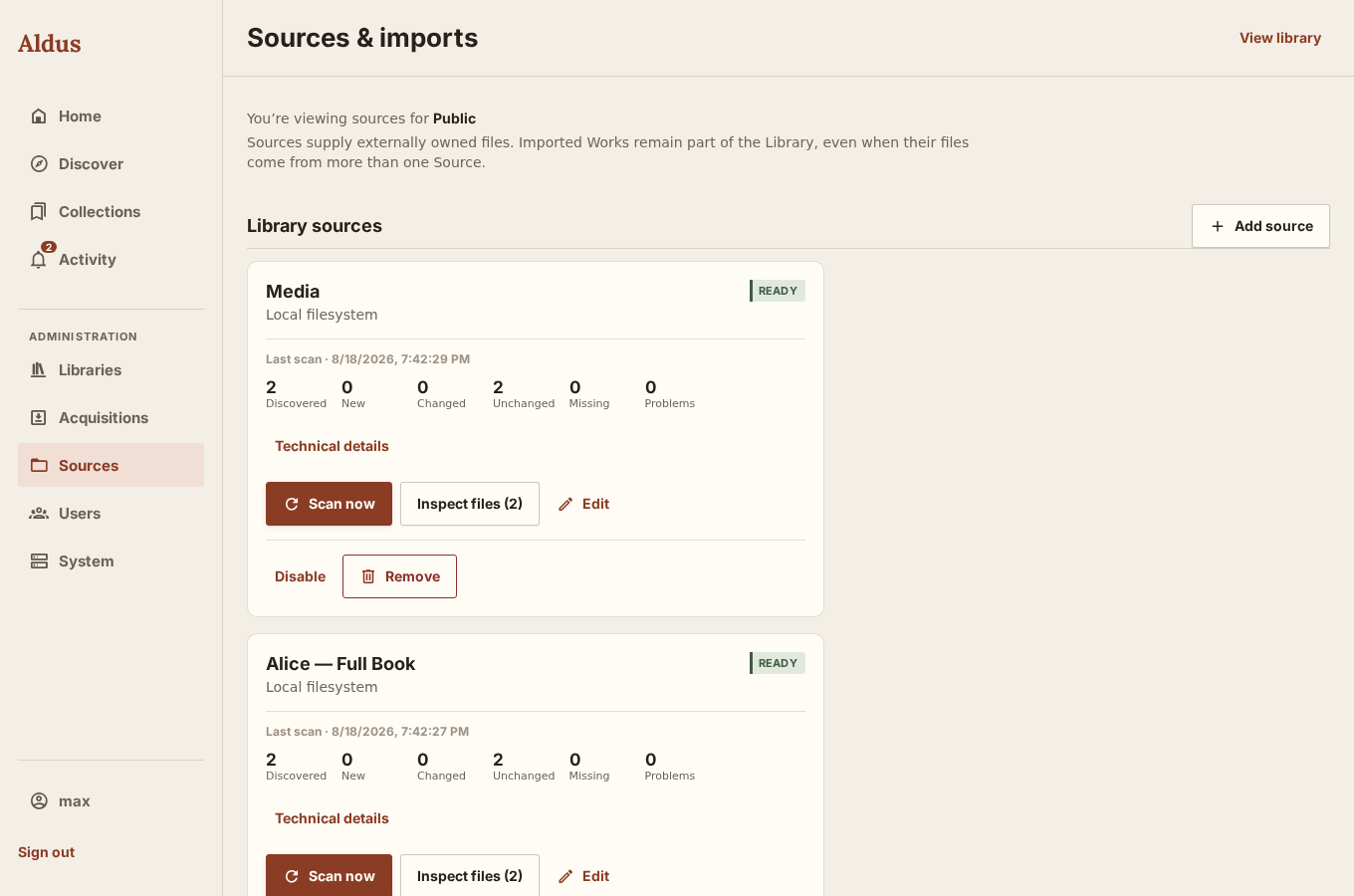
A Source points a library at a folder Aldus is allowed to scan. Client filenames never determine where Aldus stores anything — a Source only ever reads what’s already there.
Folders you already own, added by a server administrator through Add source. They stay exactly where they are on disk, mounted read-only, and are only ever indexed — never copied, renamed, or written to. Every external Source’s root must live inside the host folder mounted at ALDUS_SOURCE_PATH (see Install); Aldus rejects any path outside it.
The managed Source
Every library gets exactly one, created automatically the moment the library exists — you never add it by hand, and it doesn’t appear in the “Add source” folder picker. It lives under Aldus’s own data directory and is where completed acquisition downloads get copied once verified. It can’t be edited or deleted through the API; disabling or removing it isn’t offered in the UI at all.
Both kinds of Source are checksummed the same way: every file gets a SHA-256 hash at scan time, and Aldus re-verifies that hash (not just size and modified time) before serving a file for alignment or before finalizing a managed download copy. A managed download is written to a temporary path, hashed, moved into place, and re-hashed at its final location before Aldus trusts it.
Only a server administrator can add, edit, or delete a Source, even inside a library an editor otherwise fully manages.
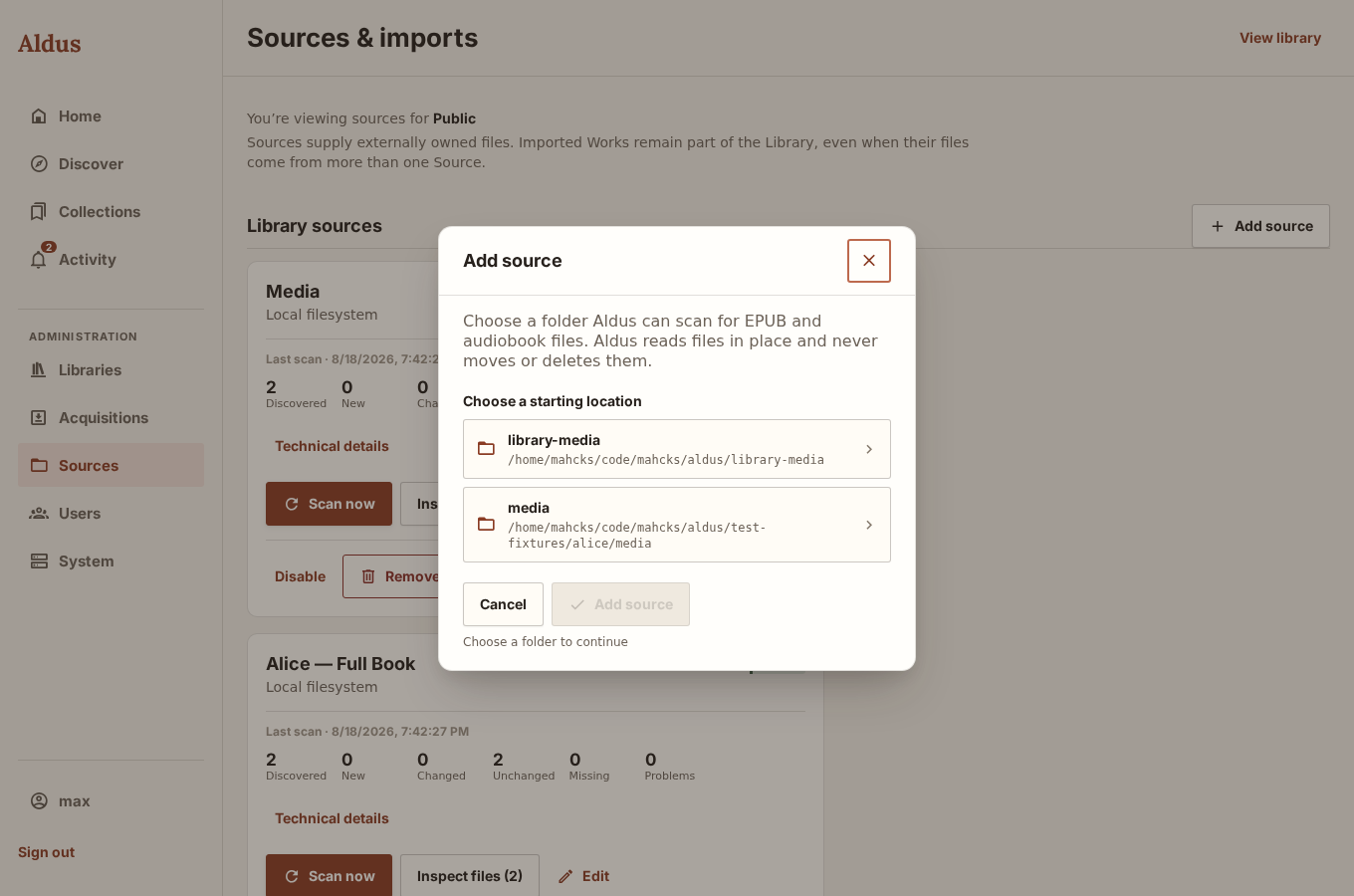
Open Sources, choose the library from the tabs if you manage more than one, and select Add source.
Pick a starting folder from the list of roots Aldus can see, then browse into the specific subfolder you want scanned — everything inside it will be scanned, including subfolders.
Name the Source and decide whether clear matches should import automatically (see below).
Aldus kicks off a first scan immediately after the Source is created.
If no root folders are available at all, the dialog explains why: an administrator needs to mount a folder into the container and list its container-visible path in ALDUS_SOURCE_ROOTS (already handled for you if you’re using the default Compose setup and ALDUS_SOURCE_PATH).
A scan is a background job, not something that happens inline while you wait. Each scan moves through pending → scanning → completed (or failed), and only one scan can be active per Source at a time — starting a second one while the first is still running is rejected outright rather than queued silently.
Aldus never follows symlinks during a scan — a symlinked file or folder inside a Source is invisible to it entirely, which is a deliberate safety boundary, not a bug. For every file it does see, Aldus:
Computes a SHA-256 hash.
Classifies it against the last scan as new, changed, or unchanged, and marks anything previously seen but now absent as missing.
For EPUBs: parses the zip defensively (path-traversal entries are rejected, entry count is capped at 10,000, expanded size is capped at your ALDUS_MAX_UPLOAD_BYTES) and pulls title, author, language, publisher, date, series, and cover presence straight out of the file.
For audio: runs ffprobe with a 30-second timeout to pull duration and format details.
The scan card’s counters — Discovered, New, Changed, Unchanged, Missing, Problems — are exactly these classifications from the most recent run.
After a scan, Aldus groups every newly registered file by normalized title and author and proposes a match at one of three confidence levels:
High — title and author agree exactly. If the Source has auto-import enabled, these skip review entirely and go straight into the library.
Medium — the same normalized title maps to more than one distinct author, or there’s more than one file of the same kind (two different EPUBs claiming to be the same book) that need a human to pick the right edition or narration.
Low — title or author is missing outright.
Anything below High, or anything in a Source without auto-import turned on, waits in Import review for a person to accept or ignore it. Accepting re-opens and re-hashes the underlying file first, so a proposal that was generated minutes ago is still checked against what’s actually on disk right now — if the file changed in the meantime, or if someone else already resolved the same proposal, Aldus refreshes it and asks you to look again rather than silently applying a stale decision.